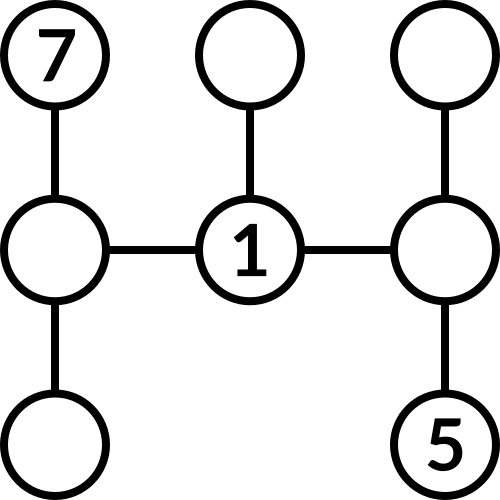
Answer
Reasoning
The largest possible difference is when 1 is next to 8, a difference of 7. Since we have 7 differences to find, and the largest possible difference is 7, all of the possible differences must exist: 1, 2, 3, 4, 5, 6, 7, and let's call these D1, …, D7.
D7 can only happen when:
1 is next to 8 = D7
D6 can happen when:
1 is next to 7, but these are given numbers that are not next to each other.
2 is next to 8 = D6
Where can we place the 8? If we put 8 above 1, we cannot also satisfy D6 (2 is next to 8).
Therefore, we have two possibilities:
(a) 8 to the left of 1
(b) 8 to the right of 1
(a) 8 to the left of 1
By D6, 2 would be below 8, and this would give us D1, D6, D7. What can we place to the right of 1?
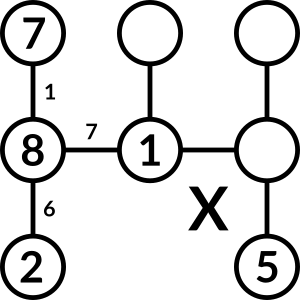
Not 3, because the difference between 1 and 3, and the difference between 3 and 5, are both D2.
Not 4, because the difference between 4 and 5 is D1, which we would already have.
Not 6, because the difference between 5 and 6 is D1, which we would already have.
There are no possible numbers we can place to the right of 1, so 8 can't go to the left of 1.
(b) 8 to the right of 1
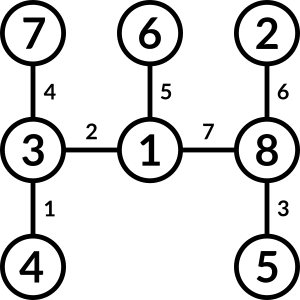
By D6, 2 would be above 8, and this would give us D3, D6, D7.

4 can't go next to 1, otherwise we'd create another D3. Therefore, 4 goes in the bottom left corner.

We are now left with 3 and 6.
If 6 went above 4, and 3 above 1, these would both be D2.
Therefore, 3 goes above 4, 6 goes above 1.
The final answer is: