X
It is now four years since I first asked for support, and I would like to sincerely thank everyone who has helped me. BrainBashers doesn't show adverts, and I continue to depend on the ongoing support from everyone who enjoys the site.
support BrainBashers
?
Puzzle 461
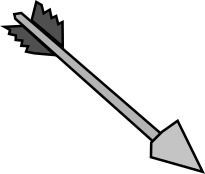
You can imagine an arrow in flight, toward a target. For the arrow to reach the target, the arrow must first travel half of the overall distance from the starting point to the target. Next, the arrow must travel half of the remaining distance.
For example, if the starting distance was 10m, the arrow first travels 5m, then 2.5m.
If you extend this concept further, you can imagine the resulting distances getting smaller and smaller. Will the arrow ever reach the target?
Hint
This puzzle needs some very careful thinking.
Answer
Yes.
Since the arrow does indeed hit the target, it must be true that 1⁄2 + 1⁄4 + 1⁄8 + … = 1.
This is because the sum of an infinite series can be a finite number.
?
Puzzle 462
A coin collector decides to divide his coin collection between his children.
The eldest gets 1⁄2 of the collection, the next gets 1⁄4 of the collection, the next gets 1⁄5 of the collection, and the youngest gets the remaining 49 coins.
Therefore, the 20⁄20 must equal 20 lots of 49 = 980.
Alternative Reasoning
Using percentages:
50% + 25% + 20% = 95%
The remaining 5% is 49 coins.
If 5% is 49 coins, 10% is 98 coins, 100% is 980 coins.
Double-Checking 1⁄2 of 980 is 490 1⁄4 of 980 is 245 1⁄5 of 980 is 196
and the remaining 49 coins.
And 490 + 245 + 196 + 49 = 980.
??
Puzzle 463
Farmer Stone is quite an eccentric dairy farmer.
He originally had a total of 54 gallons of milk in three churns, and he wanted to make sure each churn contained 18 gallons of milk.
In order to do this, he did the following:
First, he poured 1⁄4 of the first churn into the second churn. He then poured 1⁄2 of the second churn into the third churn. Finally, he poured 1⁄3 of the third churn into the first churn.
How many gallons did each churn contain before Farmer Stone started pouring?
Hint
Try working backwards, with each churn containing 18 gallons.
Answer
12, 33, and 9 gallons respectively for churns 1, 2, and 3.
Reasoning
Working backwards, at the end after Pour 3, the churns (C1, C2, C3) contained:
C1 C2 C3
————————————
18 18 18 after Pour 3
Pour3 was 1⁄3 of C3 into C1, the remaining 2⁄3 has to be the 18 gallons left in C3 after the pour, which means that 1⁄3 is 9 gallons. So 9 gallons was poured from C3 into C1. Before Pour3, C1 must have contained 9 gallons, and C3 contained 27 gallons.
C1 C2 C3
————————————
9 18 27 after Pour 2
18 18 18 after Pour 3
Pour2 was 1⁄2 of C2 into C3, the remaining 1⁄2 has to be the 18 gallons left in C2 after the pour, which means that 1⁄2 is 18 gallons. So 18 gallons was poured from C2 into C3. Before Pour2, C2 must have contained 36 gallons, and C3 contained 9 gallons.
C1 C2 C3
————————————
9 36 9 after Pour 1
9 18 27 after Pour 2
18 18 18 after Pour 3
Pour1 was 1⁄4 of C1 into C2, the remaining 3⁄4 has to be the 9 gallons left in C1 after the pour, which means that 1⁄4 is 3 gallons. So 3 gallons was poured from C1 into C2. Before Pour2, C1 must have contained 12 gallons, and C2 contained 33 gallons.
C1 C2 C3
————————————
12 33 9 at the start
9 36 9 after Pour 1
9 18 27 after Pour 2
18 18 18 after Pour 3


 It is now four years since I first asked for support, and I would like to sincerely thank everyone who has helped me. BrainBashers doesn't show adverts, and I continue to depend on the ongoing support from everyone who enjoys the site.