Puzzle 437
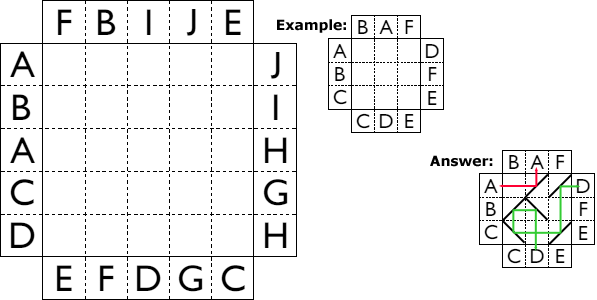
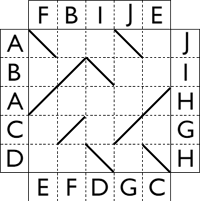
Your objective is to place some diagonal mirrors into the grid.
If a ray of light is shone in to the grid from each of the letters, and allowed to bounce off the internal diagonal mirrors, each will exit the grid at the twin of the letter that it entered the grid. For example, a ray entering at either letter D will bounce off some mirrors and exit the grid at the other letter D.
Each row and each column will contain exactly two of the diagonal mirrors.
Puzzle Copyright © Elliott Line This puzzle appeared in Mensa's EnigmaSig (196.26) and is used with permission.
workings
hint
answer
print
www.brainbashers.com
/puzzle/zbtc
share
Hint
Try starting with A and B.
Answer
Puzzle 438
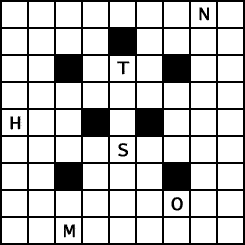
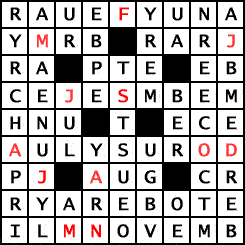
Place JANUARY, FEBRUARY, MARCH, APRIL, MAY, JUNE, JULY, AUGUST, SEPTEMBER, OCTOBER, NOVEMBER, DECEMBER, into the grid. The sequence will snake around, but cannot go diagonally, nor cross itself.
Puzzle Copyright © Cihan Altay
workings
answer
print
www.brainbashers.com
/puzzle/zzvx
share
Answer
Puzzle 439
Can you find a word starting with BR …
… that with the addition of the letter E becomes another word that sounds the same as the first?
Puzzle Copyright © Kevin Stone
workings
hint
answer
print
www.brainbashers.com
/puzzle/zcxt
share
Hint
There are at least two different answers.
Answer
BRAKING becomes BREAKING
or
BROWS becomes BROWSE
Puzzle 440
Can you find three consecutive odd numbers that …
… total 1,287 when multiplied together?
Puzzle Copyright © Kevin Stone
workings
hint
answer
print
www.brainbashers.com
/puzzle/zamh
share
Hint
There are two different methods, one involves a cube root, and the other doesn't require a calculator.
Answer
9 x 11 x 13.
Reasoning #1
We're after three numbers that multiply together, so a good place to start is the cube root of 1,287, which is roughly 10.88.
Let's try dividing by the closest odd number to 10.88:
1287 ÷ 11 = 117
We're now after whole divisors of 117. Trying the odd numbers either side of 11 might work.
Trying either 9 or 13 gives the answer:
9 x 11 x 13 = 1,287
Trying the closest odd number to the cube root always works, and the other two numbers are the odd numbers either side.
Reasoning #2
We after three numbers that multiply together, but none of these can end in 5 (otherwise our answer would end in 0 or 5).
So, they can only end in 7, 9, 1 (e.g. 87, 89, 91), or 9, 1, 3 (e.g. 89, 91, 93).
However, if they ended in 7, 9, 1, the answer would end in 3 (because 7 x 9 x 1 = 63).
Therefore, they end in 9, 1, and 3 (because 9 x 1 x 3 = 27).
The first numbers we can try are 9, 11, 13:
= 9 x 11 x 13
= 99 x 13
= 100 x 13 − 13
= 1300 − 13
= 1,287
A calculator is not required!
next >