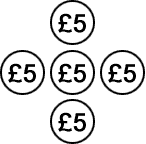
The other day I was sitting in my local tavern, The Spyglass, which overlooks the sea, when in sailed my old friend the pirate Captain Conan Drum. "Well, shiver me barnacles!" he roared on seeing me. He too is a bit of a puzzle addict and so, after joining me for a glass of milk and telling me about his latest exploits on the high seas, he couldn't resist showing me his latest conundrum.
He reached into one of his jacket pockets and produced seven gleaming £5 coins, which he then proceeded to arrange on the table in front of me exactly as shown below. "Now, me lad." he said, with a mischievous look in his eyes. "I'll wager you'll not be able to solve this one. Take away two coins from this here arrangement to leave five coins across and three coins going down."
It was clear the wily old sea dog still had one or two tricks up his sleeve, as I couldn't for the life of me see how it could be done. Can you see through his skulduggery and solve it?
As I was going to St Ives,
I met a man with seven wives.
Each wife had seven sacks,
Each sack had seven cats,
Each cat had seven kits.
Kits, cats, sacks and wives,
How many were going to St. Ives?
This is a very old puzzle, and appeared in a manuscript dated around 1730. It is thought to refer to a town in Cornwall, UK.
If we were to count everyone and everything, including all of the kits, cats, sacks and wives, we would have:
Me = 1
Man = 1
Wifes = 7
Sacks = 7 x 7 = 49
Cats = 7 x 7 x 7 = 343
Kits = 7 x 7 x 7 x 7 = 2401
A million grains of sand is a heap. If we remove one grain of sand from this heap, we will still have a heap.
We can now keep repeating (2) until we only have a single grain of sand remaining.
Is this a heap? Clearly not. But what went wrong with our thinking?
This is called the Sorites paradox (soros being Greek for "heap") and is a classic paradox that has no real answer.
Both (1) and (2) are true, and we can indeed keep removing one grain of sand until we have a single grain remaining. If we remove one more grain, we're left with nothing, is this still a heap?