At the recent BrainBashers Mixed National Hurdle trials, ten contestants competed for the coveted BB Shield.
There were numerous judges who made sure that the results were accurate, from their notes can you determine who finished where?
Crystal Ball finished before May Eye and Mike Stup, while Leigh Vamessage was victorious over May Eye and Laura DeLand. Jack Pott was beaten by Holly Day, Mike Stup, and Justin Time. Laura DeLand was beaten by Mike Stup, May Eye, and Crystal Ball, whereas Joe King beat Holly Day and Jack Pott, but lost to Laura DeLand and Inga Hootz. Leigh Vamessage was beaten by Crystal Ball and Inga Hootz. Inga Hootz was beaten by Justin Time, who, in turn, lost to Crystal Ball, but beat Holly Day and Jack Pott. May Eye finished ahead of Mike Stup and Holly Day (who lost to Leigh Vamessage and Inga Hootz).
Hint
Rewrite the clues so that those who finished ahead are written first.
Answer
Crystal Ball (CB)
Justin Time (JT)
Inga Hootz (IH)
Leigh Vamessage (LV)
May Eye (ME)
Mike Stup (MS)
Laura DeLand (LD)
Joe King (JK)
Holly Day (HD)
Jack Pott (JP)
Reasoning
If we number the clues, write each name using two letters, and rewrite the clues so that those who finished ahead are written first:
CB beat ME and MSLV beat ME and LDHD, MS, and JT, all beat JPMS, ME, and CB, all beat LDJK beat HD and JPLD and IH both beat JKCB and IH both beat LVJT beat IHCB beat JTJT beat HD and JPME beat MS and HDLV and IH both beat HD
By (9): CB JT
By (8): CB JT IH
By (7): CB JT IH LV
By (2): CB JT IH LV ME
By (11): CB JT IH LV ME MS
By (4): CB JT IH LV ME MS LD
By (6): CB JT IH LV ME MS LD JK
By (5): CB JT IH LV ME MS LD JK HD
By (3): CB JT IH LV ME MS LD JK HD JP
Reasoning
The easiest way to solve this puzzle is to use Q1 to check the logic.
If Q1's answer was A, this tells us that Q2's answer is B, which tells us Q3's is D, which tells us Q4's answer is B, which tells us Q1's answer is C. A contradiction.
If Q1's answer was B, this tells us that Q2's answer is A, which tells us Q3's is C, which tells us Q4's answer is C, which tells us Q1's answer is A. A contradiction.
If Q1's answer was C, this tells us that Q2's answer is D, which tells us Q3's is A, which tells us Q4's answer is D, which tells us Q1's answer is B. A contradiction.
If Q1's answer was D, this tells us that Q2's answer is C, which tells us Q3's is B, which tells us Q4's answer is A, which tells us Q1's answer is D. Which is correct, and therefore the correct answer.
??
Puzzle 187
W B H F S K F V J P Z H S S H T J P P N W L A F P W P N T D S W S T R H S P L M V R G B I D P B D W S N R T C S R S F T D B K K F B O M F R L Z F R K Y P N J Z J S Z N M B J Q E R Z F Q Z V G Y F V P P F G F W Z W N R P L B J V R J H F K T Z U H F K Y F W J F S R S S W C Q R Q Y H R S O M W F P R Q J K H R N M B W S K B J Y D Q E T J Y P F D L R P F
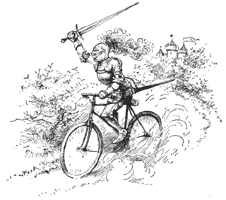
In the illustration we have a sketch of Sir Edwyn de Tudor going to rescue his love, who was held captive by a neighbouring wicked baron.
Sir Edwyn calculated that if he rode at fifteen miles an hour he would arrive at the castle an hour too soon, while if he rode at ten miles an hour he would get there just an hour too late.
Now, it was of the first importance that he should arrive at the exact time appointed, in order that the rescue that he had planned should be a success, and the time of the tryst was five o'clock, when the captive would be taking afternoon tea.
The puzzle is to discover exactly how far Sir Edwyn de Tudor had to ride.
Sir Edwyn De Tudor, Amusements In Mathematics, Henry Ernest Dudeney.
If Sir Edwyn left at noon and rode 15 miles an hour, he would arrive at four o'clock, which is an hour too soon. If he rode 10 miles an hour, he would arrive at six o'clock, which is an hour too late. But if he went at 12 miles an hour, he would reach the castle of the wicked baron exactly at five o'clock, which is the time appointed.
The text above is the answer given in the book, and below is a method of finding the answer.
If we call the distance to the castle, D and use the fact that Time = Distance ÷ Speed, we have:
Travelling at 15 mph:
Time1 = D ÷ 15 (an hour too soon)
Travelling at 10 mph:
Time2 = D ÷ 10 (an hour too late)
The time gap between these two times is 2 hours, therefore