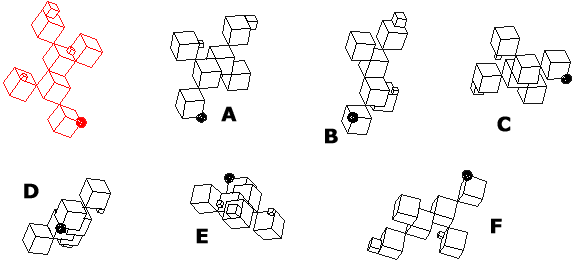
A well-known seven-letter word can be created, by starting with a single letter and adding a letter, one at a time, then mixing the letters, each time making a proper word. Using the clues below, which are not necessarily in the correct order, can you find all seven words? For example, A, AT, TAR, RATE, etc.
Expressing position within limits of space and time. The subject of self-consciousness. Frozen atmospheric vapour falling to earth. To utter musical sounds with the voice. Cause to oscillate. Scattering on the earth. The breaking of divine law.
Hint
The longest word is the answer to 'Frozen atmospheric vapour falling to earth'.
Answers
Snowing, sowing, swing, sing, sin, in, I.
snowing – frozen atmospheric vapour falling to earth
sowing – scattering on the earth
swing – cause to oscillate
sing – to utter musical sounds with the voice
sin – the breaking of divine law
in – expressing position within limits of space and time
I – the subject of self-consciousness
Answer
In the phrase 'my bucket and your spade', the gap between 'my' and 'and' is the same as the gap between 'and' and 'spade', namely one word.
Indeed, this logic can be continued to give the following sentence. In the first sentence the gap between 'and and' and 'and and' is seven words, et cetera.
The weather at the Cape of Good Hope makes it a notorious location where many ships have been lost to the sea. Philip Wood, the famous diver, has discovered four ships that sank in the same spot, one on top of each other.
With some skill, Philip was able to determine the name, captain, cargo, destination and year built for all of the ships. The question is, can you?
During his first exploration of the site, Philip determined there were four ships: the Red Rover, the ship built in 1743, the ship captained by Quigley and the ship carrying tea that was bound for North America. The ship that carried a cargo of saffron was built after the ship that carried a cargo of tea. An entry in one ship's log found at the site indicated that the ship built in 1522 was carrying a valuable cargo of gold. One ship was carrying botanical specimens to France. Philip determined that this was not the Royal Bride. The Scarlet Queen, a pirate ship, was certainly built before the nineteenth century but not as early as the sixteenth. The captain of this ship was the famous rogue Clubfoot. The Wanderer was built after the Royal Bride. The Royal Bride's cargo was not tea and the Royal Bride was not travelling to the South Seas. Captain Bolton's ship was built before Clubfoot's and before The Royal Bride.
Ships : Red Rover, Royal Bride, Scarlet Queen, Wanderer
Year Built : 1522, 1688, 1743, 1817
Captain : Bolton, Clubfoot, Quigley, Vickers
Cargo : Gold, Saffron, Specimens, Tea
Destination : England, France, North America, South Seas
Answer Name Year Captain Cargo Destination Royal Bride 1743 Vickers Saffron England Scarlet Queen 1688 Clubfoot Tea North America Red Rover 1522 Bolton Gold South Seas Wanderer 1817 Quigley Specimens France
The ship built in 1522 was carrying gold (3). This is not the Scarlet Queen (5), the Wanderer (6) or the Royal Bride (7) so must have been the Red Rover. The Scarlet Queen was built in either 1688 or 1743 (5) and the Wanderer was built after the Royal Bride so the Wanderer was built in 1817 and the Royal Bride in either 1688 or 1743 so the captain of the Red Rover was Captain Bolton (7). The ship carrying tea was not the Red Rover (gold), the Royal Bride (6) or the Wanderer (2) so was the Scarlet Queen. The Scarlet Queen's destination was North America (1) and her captain was Clubfoot (5). The Scarlet Queen was not built in 1743 (1) so was built in 1688 and the Royal Bride was built in 1743. The Royal Bride was not carrying gold (Red Rover), tea (Scarlet Queen) or botanical specimens (4) so was carrying saffron and the Wanderer was carrying the specimens to France. Quigley was not the captain of the Royal Bride (1) so was the captain of the Wanderer and Vickers was the captain of the Royal Bride. The Royal Bride's destination was not the South Seas (6) so was England and the Red Rover's destination was the South Seas.