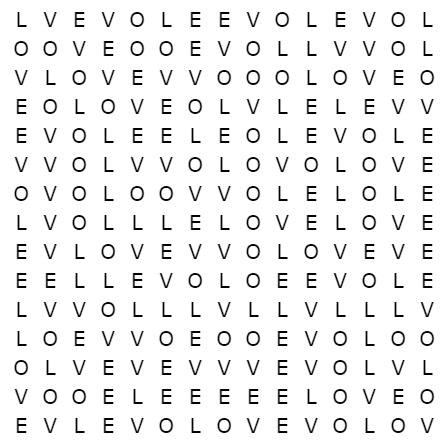
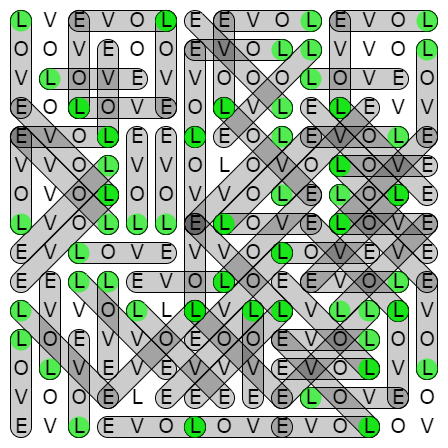
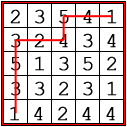
In the solution below you can see 6 squares in the middle, with another 12 squares around the outside.
Puzzle 52
In the following sum the digits 0 to 9 have all been used, O = Odd, E = Even, zero is even and the top row's digits add to 9. Can you determine each digit?
Hint: The largest possible numbers could start with 6 and 8, therefore the first digit of the answer is 1.
Answer:
Remembering that:
E + E = E
O + O = E
E + O = O
To discuss individual letters it's easiest to represent the sum as:
A B C
D E F +
--------
G H I J
The largest values for A and D are 6 and 8, which makes G = 1.
Since column 2 is E + O = O there can be no carry from column 1 (since E + O + 1 is always even). Therefore C and F are 3 and 5 (but we don't yet know which is which), therefore J = 8.
There can't be a carry from column 2 (as A + D is even) therefore E can't be 9 as this would force a carry.
Therefore I = 9. Hence B can't be 0. Therefore H = 0.
The last remaining odd number makes E = 7. Making B = 2.
Therefore A and D are 4 and 6 (but we don't yet know which is which).
Since the top row's digits have to add to 9 the top number must be 423.
This makes the sum 423 + 675 = 1098. QED.
Puzzle 53
What three-letter word best completes the below words?
Three countrymen met at a cattle market. "Look here," said Hodge to Jakes, "I'll give you six of my pigs for one of your horses, and then you'll have twice as many animals here as I've got."
"If that's your way of doing business," said Durrant to Hodge, "I'll give you fourteen of my sheep for a horse, and then you'll have three times as many animals as I."
"Well, I'll go better than that," said Jakes to Durrant; "I'll give you four cows for a horse, and then you'll have six times as many animals as I've got here."
No doubt this was a very primitive way of bartering animals, but it is an interesting little puzzle to discover just how many animals Jakes, Hodge, and Durrant must have taken to the cattle market.
[Ref: ZUCK] At A Cattle Market. Amusements In Mathematics by Henry Ernest Dudeney (1917).
Hint: A little algebra might help.
Answer:
Jakes must have taken 7 animals to market, Hodge must have taken 11, and Durrant must have taken 21. There were thus 39 animals altogether.
This can be solved with a little algebra, where J - Jakes, H = Hodge and D = Durrant:
From the clues:
2 x (H - 6 + 1) = J + 6 - 1 [1]
3 x (D - 14 + 1) = H + 14 - 1 [2]
6 x (J -4 + 1) = D + 4 - 1 [3]
These can be rearranged to give:
2H - J = 15 [4] 3D - H = 52 [5] 6J - D = 21 [6]
We can now use 2 x [5] + [4] to give:
6D - J = 119 [7]
We can now use [7] + 6 x [6] to give:
35J = 245 J = 7
We can then use J = 7 in [4] and [6] to give H = 11, and D = 21. QED.
Puzzle 55
Using the BrainTracker grid below, how many words can you find? Each word must contain the central B and no letter can be used twice, however, the letters do not have to be connected. Proper nouns are not allowed, however, plurals are. There is at least one nine letter word. Excellent: 48 words. Good: 33 words. Average: 28 words.